More reviews from every spot in the hotel.

A code at the front desk, the bar and every room. Guests scan or tap once, review on Google or Tripadvisor, and you see which spot earned it.

No app for guests · No hardware to buy · Print and go

Live demo — tap a button
+11.2%

price a hotel can charge at the same occupancy for a one-point rise in its review score (5-point scale)

Cornell Center for Hospitality Research, via Hospitality Net, 2012
76%

of travellers will pay more for a hotel with a higher review score

TrustYou / NYU study, via Hospitality Net, 2014
~3 weeks

without a new review before Google Maps rankings start to slide; review recency moved from #20 to a top-5 factor

Whitespark, 2025

See which spot works. Move the ones that don't.

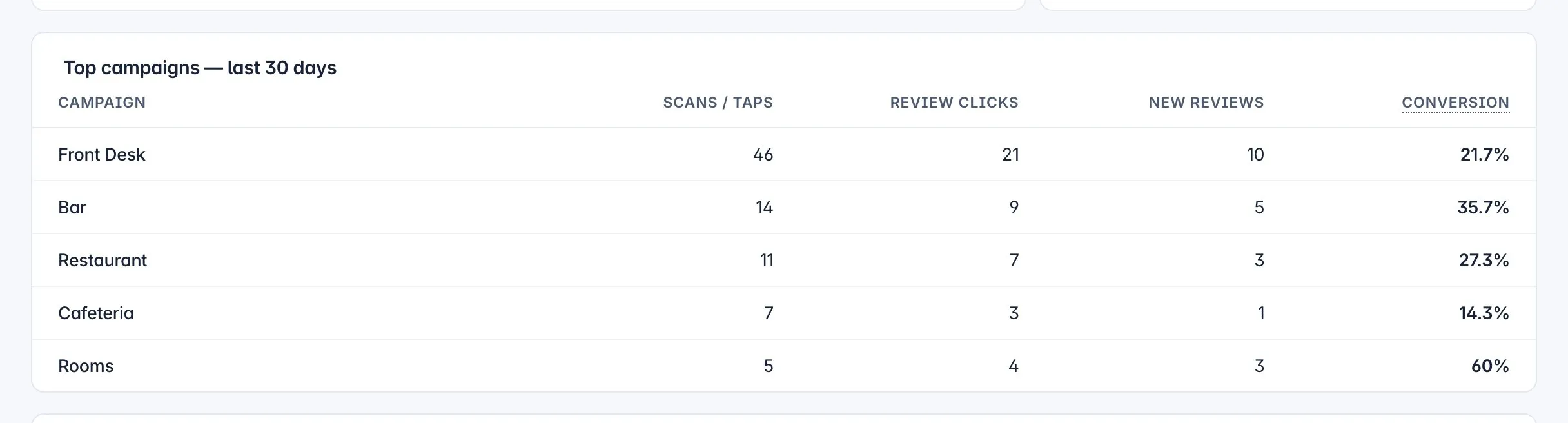
One review link tells you reviews arrived. One code per spot tells you where. Spots are compared, never people.

Top campaigns leaderboard — the bar card against the room card
Sample data

Every guest, every button, every rating.

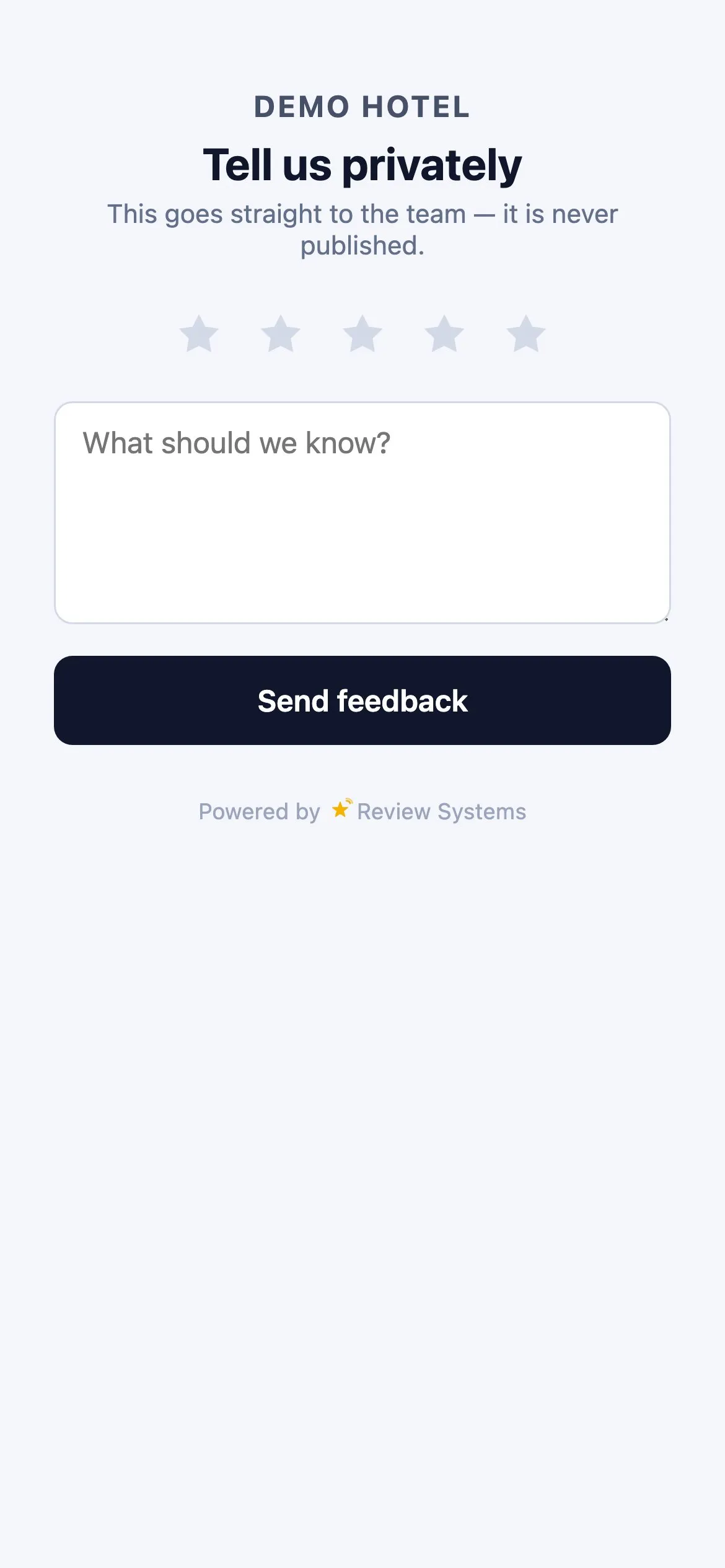
Google and Tripadvisor stay on the page whatever the guest rates. A private note reaches the manager and never a listing — an extra door, not a detour.

Private feedback form: stars and a message that reaches the manager, never the listing
Sample data

What does Review Systems do for hotels?

For a hotel, Review Systems is a set of printed codes and one guest page. Each spot in the property — the front desk, the bar, the restaurant, the spa, the rooms — gets its own QR sticker, table tent, poster or NFC tag, and every code opens the same branded page: a Google review, a Tripadvisor review, or a private word to the manager. Reviews that appear on Google or Tripadvisor within the spot's attribution window are matched back to the scan or tap that preceded them, with the confidence shown. The result is a leaderboard of spots rather than a single review count, so a general manager can see that the bar card produces reviews and the lift poster does not, and move the paper instead of guessing. One login holds every property in a group; access is granted per property, so the bar manager can be invited to the bar alone.

Where a hotel’s reviews actually come from

Most hotels have one review link, printed once, and no idea which guests use it. Give every spot its own code and the question changes from “are we getting reviews?” to “which spot is getting them?” The code where the phone already is wins: a tent at breakfast and a coaster at the bar beat a poster by the lift, and room cards work when the front desk mentions them at check-in.

What to print first

Spot Item What you learn
Front desk 60 mm table tent, angled to the guest, plus an NFC tag under the counter edge The baseline every other spot is read against
Bar and breakfast 60 mm tents or coasters Usually the best scan-to-review rate in the building
Rooms 25 mm sticker on the key card holder or welcome note Many scans, fewer taps; the 72-hour window catches the review written from home
Spa, valet, lift 25 mm sticker or 150 mm poster Idle for seven days? The notification says so; it is probably in the wrong place

Export the file, scan it once with your own phone, then order the print run. Reprinting is the expensive step.

For hotel groups

One login, every property. The switcher scopes every page, stat, report and alert to one property or to all of them, and roles hang off the property: a Manager sees reviews and codes, an Admin can invite people, an Owner has full control.

"But we already…"

You might sayFair — and here is the difference
Google gives us a QR code for free.It does, and it works. It is one code for the whole hotel, so it cannot tell you the bar earned the review and the lobby poster did not. No Tripadvisor button, no private door.
We already send a post-stay email.Keep sending it. The email reaches the guest two days later in an inbox; the code reaches them at the bar while the drink is still on the table. The spot report shows which one produces.
We tried review cards from Amazon.Same idea with the software missing: no Tripadvisor, no attribution, no private feedback, and no way to know which of the twenty cards is doing the work.
Our team will forget to mention it.The best placement is the one next to a person. A staff member saying "there is a code on the card" moves scans more than any design change, and the leaderboard shows where it is being said.

Questions buyers ask first.

Which review sites can a hotel guest choose from?

Google and Tripadvisor side by side, with Yelp if you connect it, plus a private message to the manager. Every button is on the page at every rating; the order and wording are yours to set in the guest page designer.

How many codes does a 60-room hotel need?

Fewer than you think. Start with three spots: the front desk, the bar or breakfast room, and the rooms. Rooms share one spot with one code per room card, so a review credited to Rooms still tells you the card works without tracking each door. Add the spa or valet once the first three have numbers.

What about Booking.com or Expedia reviews?

Those are written inside the OTA's own app after checkout and a printed code cannot open that form, so Review Systems does not claim them. It focuses on the two public platforms a guest can reach from a phone at the spot: Google and Tripadvisor.

Will the codes break when we refurbish and rename the bar?

No. A published address is never taken back. Renaming a spot publishes a new address and the old one keeps resolving forever, so the coasters you printed last year keep counting.

Can the general manager of one property see the others?

Only if invited. Access hangs off the property, not the login: an owner can hold ten hotels and invite each GM to their own, and a group revenue manager can be given all of them.

Read the full FAQ → or contact us

Print one code today.

Add your property, print a code for one spot, and watch the first review land credited.