The arithmetic nobody does
Take a 60-room hotel at 70% occupancy with an average stay of two nights. That is about 630 departing rooms a month. If one guest in ten reviews unprompted, the hotel gets around 60 reviews a year without asking. If two thirds review when asked, the same hotel asking every guest gets that many in a month.
The gap between those two numbers is not marketing. It is whether anyone asked.
Where to ask
The ask works where the phone already is and where someone can point at it.
- The table at the end of a meal beats a poster by the exit. The guest is seated, finished, and looking at the phone anyway.
- The bar is the same moment with a drink in hand.
- The front desk at check-out is the one spot every guest passes with a staff member present.
- Room cards work when the desk mentions them at check-in and rarely otherwise.
- Next to a person. A staff member saying “there is a code on the card” moves scans more than any design change.
Write the purpose next to the code. In EasyMenus’ data a code with its purpose written beside it was scanned 73% of the time against 34% for a bare one.
Make the ask one tap long
A QR code or an NFC tag opens the review form directly. No app, no account, no typing a URL. The page the guest lands on should have one filled button for the platform you care about most and the others one tap away, so the choice is not split three ways.
Give a guest who wants to write something a way to find the words — a rating, one or two things that stood out, a short draft they can edit — and let them post it themselves. Reviews with text outrank star-only ratings, and a guest who has just picked “the staff” and “how clean it was” has already written most of the sentence.
Why recency matters as much as volume
Reviews are about a fifth of Google’s local ranking weight, and recency moved from a minor factor to a top-five one. Whitespark’s testing finds rankings start to slide after roughly three weeks without a new review. A hotel with 400 reviews and none this month is losing ground to a hotel with 80 and three this week.
A code at the spot is a recency machine: it asks every day, on the property’s schedule rather than the marketing team’s.
What you must never do
Google prohibits merchants who “discourage or prohibit negative reviews, or selectively solicit positive reviews from customers”, who “offer incentives … in exchange for posting any review”, and who pressure users “to leave ratings or write reviews while on the premises”. Since April 2026 the policy also names merchants “requesting that staff solicit a certain number of reviews” and reviews “that identif[y] a staff member”.
In practice:
- Show every guest every option. No pre-screen that hides the public form from anyone.
- No rewards. No discount, no free dessert, no draw — regardless of rating.
- Compare spots, not people. No targets for staff, and no asking guests to name staff.
- Invite, do not pressure. The code sits on the table; nobody stands over the guest.
- Let the guest write and post. A helper may suggest words from the guest’s own taps; it must never post for them or hand every guest the same paragraph.
Measure the spot, not the listing
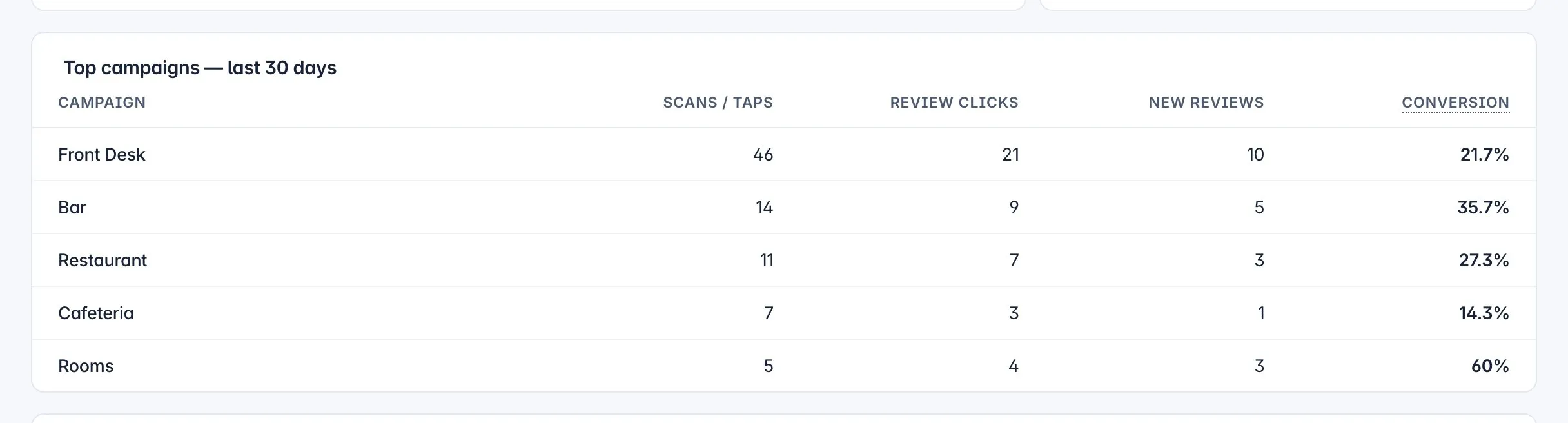
One review link printed once tells you reviews arrived. One code per spot tells you where. Give each spot — front desk, bar, rooms, restaurant — its own code, and read the leaderboard after a month. Move the paper that is not working. Print more of the paper that is.
That is the whole method: ask everyone, at the spot, by the rules, and know which spot did it.

 ChatGPT
 Perplexity
 Claude
 Gemini · Google AI Mode
 Reddit
 X
X