How long to ten reviews.
Rooms, occupancy and how many guests you actually ask, turned into reviews a month and months to the published ranking thresholds. Illustrative arithmetic, adjustable defaults.
Your numbers.
departing guests a month
asked at a spot
new reviews a month — 14.2× today's 4
| Threshold | Where it comes from | You |
|---|---|---|
| 10 reviews — first visible ranking boost | Sterling Sky | Already there |
| One review every ~21 days — recency kept | Whitespark | Kept |
| 309 reviews — the average hotel | BrightLocal | 4 months |
Illustrative arithmetic, not a forecast: it multiplies your inputs. The thresholds are published findings, linked on this page; your market decides how many reviews the 3-pack takes.
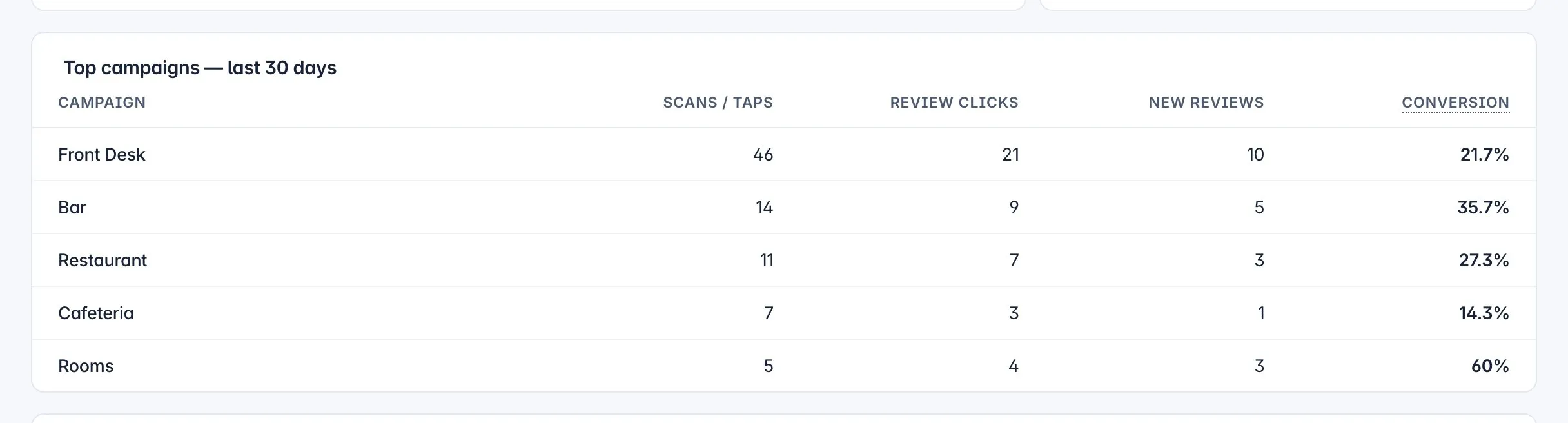
The number this cannot give you is which spot produces the reviews — the front desk, the bar or the rooms. That is what Review Systems adds. See how spot attribution works →
The thresholds, and where they come from.
| Figure | Claim | Source |
|---|---|---|
| 10 reviews | is the point at which a Google Business Profile earns a visible ranking boost; reviews with text outrank star-only reviews | Sterling Sky, 2025 |
| ~3 weeks | without a new review before Google Maps rankings start to slide; review recency moved from #20 to a top-5 factor | Whitespark, 2025 |
| 309 | Google reviews is the average for a hotel; the top three local results average 47 against 38 for positions 7–10 across categories | BrightLocal Google Reviews Study, 2024 |
| 65–83% | of customers leave a review when asked, against roughly 10% who do so unprompted | BrightLocal Local Consumer Review Survey, summarised by Growave, 2024 |
| 4.8–4.9★ | is the rating band of businesses that win the Google 3-pack, across 50.4 million search results | Local Falcon whitepaper, 2025 |
The ask-rate is the number a code changes.
Every other input is your property. Once the codes are out, the leaderboard shows which spot is delivering the reviews this page only estimates.
Questions about the arithmetic
Where do the thresholds come from?
Sterling Sky's testing finds a first visible ranking boost at ten reviews and that reviews with text outrank star-only ratings. Whitespark finds recency moved to a top-five factor and rankings slide after roughly three weeks without a review. BrightLocal puts the average hotel at 309 Google reviews. Each is linked below.
Is the 15% conversion default realistic?
It is deliberately modest. BrightLocal finds most consumers are open to writing a review and that most do so when asked; the default assumes only one asked guest in seven follows through. Put your own number in — the point of the tool is the arithmetic, not the default.
Does more reviews mean a higher ranking?
Volume, recency and rating all count, and your market sets the bar: Local Falcon's study of 50 million results finds 3-pack winners sit at 4.8–4.9 stars and that metro businesses need up to twice the reviews of rural ones. The calculator tells you how fast you can move; it cannot tell you where the finish line is in your city.
Why does Review Systems care about this?
Because the ask-rate is the number a code at the spot changes. Every other input is your property. Once the codes are out, the leaderboard tells you which spot is delivering the reviews this page only estimates.
Keep reading
Guide
How to get more Google reviews for a hotel or restaurant, by the rules
Ask at the moment, at the spot, with a code the guest can scan; show every guest every option; never reward. What the data says on volume, recency and ranking.
Guide
Review recency and Google Maps ranking: why three weeks matters
Recency is a top-five local ranking factor and rankings slide after three weeks without a review. What Whitespark, Sterling Sky and Local Falcon found.
Solution
Hotel review collection per spot — QR, NFC, links
Google and Tripadvisor reviews from the front desk, the bar and rooms, and which spot earned each one. Private feedback reaches the manager, not the listing.
Page
How Review Systems works — spot, code, guest page, attribution
Property, spot and printed code; one guest page for Google, Tripadvisor and a private note; and how a review is matched back to the scan with its confidence.
Start collecting customer feedback.
Free to use. Create your account, add your business and print your first QR code.

 ChatGPT
 Perplexity
 Claude
 Gemini · Google AI Mode
 Reddit
 X
X