What does Tripadvisor say drives the ranking?
Three things, in its own words: the quality, recency and quantity of reviews. Quality is the rating guests give. Recency is how new the reviews are, with newer reviews carrying more weight than older ones. Quantity is how many reviews a property has compared with the others in its destination.
That is the whole published formula. There is no paid tier that moves it and no partner badge that lifts it. A hotel moves its rank by receiving more reviews, more often, from guests who rate it well — which is another way of saying by asking every guest at the moment it matters.
How does recency work on Tripadvisor?
Newer reviews weigh more, and the weight decays. A property with a strong 2024 and silence since is being overtaken by one with an ordinary rating and a review every week. Tripadvisor’s own guidance frames it as consistency: the ranking rewards a steady flow of reviews, not one strong season followed by a quiet one.
This mirrors what Whitespark found on Google Maps — recency moving into the top five factors — and what Booking.com did in 2025 when it reweighted recent reviews in its score. All three platforms are converging on the same signal: is this place still as good as its reviews say?
What does Review Express do, and what does it miss?
Review Express is Tripadvisor’s free tool for emailing recent guests a review request. Tripadvisor reports that users see about 28% more Tripadvisor reviews. It reaches only guests whose email you hold, only after they leave, and only for Tripadvisor — and users must certify they have not selected who receives it.
| Review Express | A code at the spot | |
|---|---|---|
| What it needs | Guest email addresses, collected with consent | A printed card or tag |
| Reaches | Guests whose email you hold | Every guest who finishes at that spot |
| When | After departure, by email | At check-out, at the bar, at breakfast |
| Platforms | Tripadvisor only | Google and Tripadvisor side by side, plus a private route |
| Tells you | Reviews arrived | Which spot earned each review |
| Selection | You certify there was none | None possible — the card is on the table for everyone |
Use both. Review Express is a good second ask to guests who gave you an address; it cannot be the first ask, because the first ask happens while the guest is still in the building.
What does Tripadvisor forbid?
Selective solicitation and anything offered in exchange. Tripadvisor’s owner guidance is explicit that asking is welcome and equally explicit about what turns asking into a violation. The banned practice is choosing who to ask by how they seemed, whatever the channel — the words “any other means” cover a card as much as an email.
“It’s a great idea to ask guests to review your property.” Tripadvisor prohibits “selectively soliciting reviews (by email, surveys or any other means) only from guests who have had a positive experience” and any attempt to “offer or promise anything in exchange for any reviews, irrespective of rating”.
A star pre-screen that shows the Tripadvisor button to some guests and not others is that “other means”. A card that shows it to every guest is what Tripadvisor is describing when it says asking is a great idea.
Why put Google and Tripadvisor side by side on one page?
Because hotel guests use both and the hotel needs both. BrightLocal’s 2025 survey finds 85% of consumers use Google to find reviews and 74% check two or more sources before deciding. A single printed spot that offers Google and Tripadvisor on one page, to every guest, moves both rankings from one card.
The Tripadvisor Popularity Ranking decides where you sit when a traveller is comparing hotels in your city. Google’s local ranking decides whether you appear when they search “hotel near the station”. They are different moments in the same booking, and separate cards per platform — one for Google at the desk, another for Tripadvisor in the room — halve the ask at each spot.
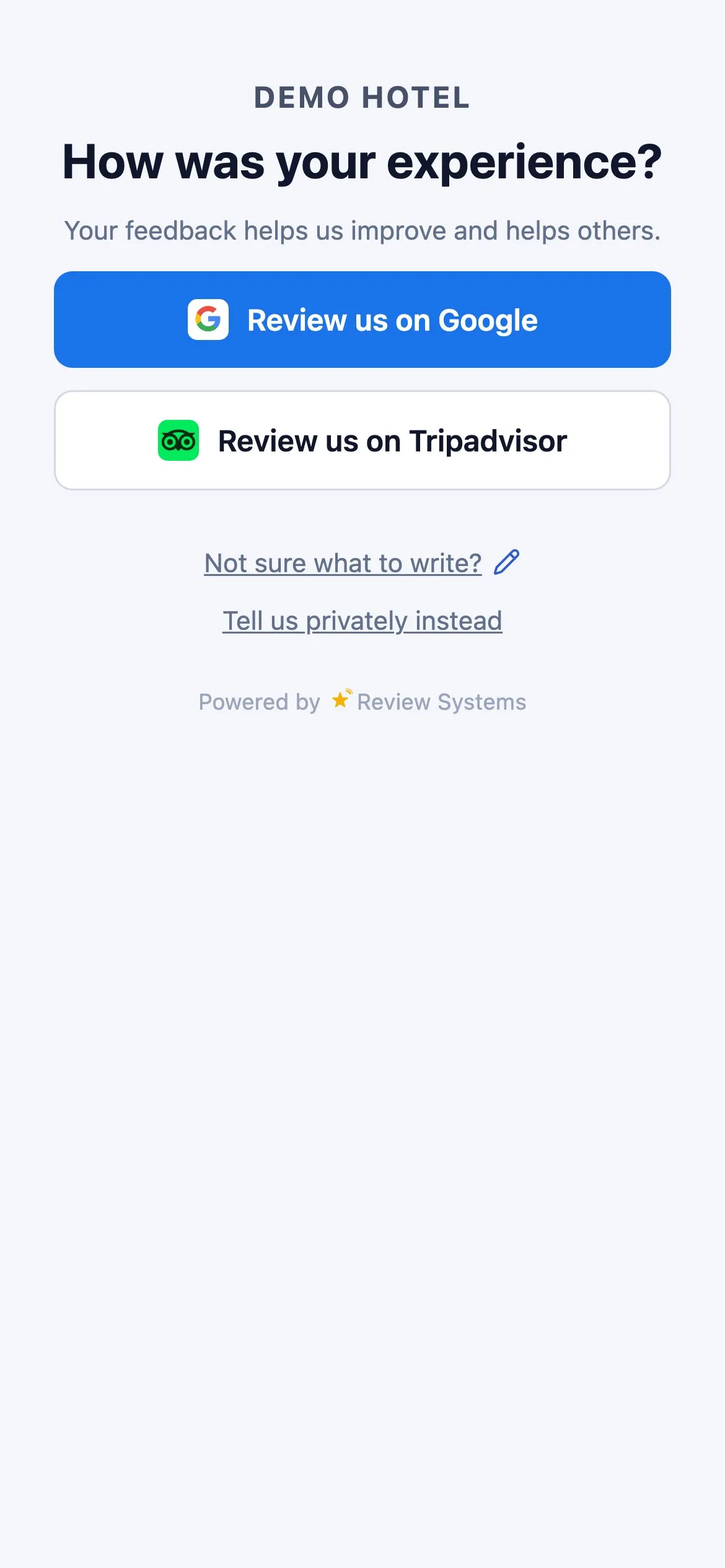
One page, one filled button for the platform you need most this quarter, the other one tap away, and a quiet private-feedback link beneath. Every guest sees every public review button at every rating; private feedback is an extra door, not a detour.
What should a hotel do?
Ask every guest at check-out, at the bar and at breakfast, with Google and Tripadvisor on the same page, and keep Review Express running behind it for guests who gave an email. Read which spot earned each review after a month, and move the card that is not working.
Quality, recency and quantity are three names for the same habit: asking everyone, at the spot, every day, by the rules Tripadvisor wrote. How to phrase that ask is in how to ask guests for reviews.

 ChatGPT
 Perplexity
 Claude
 Gemini · Google AI Mode
 Reddit
 X
X