What is review gating?
Review gating is asking a customer to rate their experience before deciding whether to show them the public review form. Guests who rate high are sent on to Google or Tripadvisor; everyone else is steered to a private form. The listing ends up showing a sample the business chose, which every rule below is written against.
It usually arrives dressed as a survey — “How was your stay?” with five stars — and the fork happens after the tap.
What does Google’s policy say?
Google’s Maps content policy prohibits selective solicitation, discouraging negative reviews, offering anything in exchange for a review, and pressuring guests to review on the premises. In April 2026 it added two clauses aimed at staff: asking them to bring in a set number of reviews, and review content that identifies an individual staff member.
Google prohibits merchants who “discourage or prohibit negative reviews, or selectively solicit positive reviews from customers”, who “offer incentives … in exchange for posting any review”, and who “require or pressure users to leave ratings or write reviews while on the premises”. Since 17 April 2026 the policy also names “merchants requesting that staff solicit a certain number of reviews” and reviews “that include specific content, including content that identifies a staff member”.
Google’s Business Profile help page is explicit that asking is fine: “you can ask customers to visit a Google link or scan a QR code”, and businesses should “value all reviews”. The line Google draws is between asking everyone and choosing who.
Google removed 292 million policy-violating reviews in 2025 (Launch Codex, summarising Google’s figures). The enforcement is automated, and a listing with almost no low ratings beside a private form that catches them is a pattern.
What does Tripadvisor say?
The same thing with broader words. Tripadvisor welcomes the ask and bans selecting who gets it by any means, plus anything offered in exchange regardless of rating. Its Review Express tool makes users certify they have not been selective, which tells you how seriously it treats the distinction.
Tripadvisor prohibits “selectively soliciting reviews (by email, surveys or any other means) only from guests who have had a positive experience” and any attempt to “offer or promise anything in exchange for any reviews, irrespective of rating”.
A star pre-screen in front of the Tripadvisor button is the “any other means”.
What does the FTC rule say?
The FTC’s rule on consumer reviews, 16 CFR 465, took effect on 21 October 2024 with civil penalties of up to $51,744 per violation. It bans fake and AI-fabricated reviews, payment conditioned on a review’s sentiment, and suppressing reviews by intimidation or unfounded legal threats. On gating specifically, the FTC says the practice could violate the FTC Act.
“The rule does not contain a specific prohibition against such conduct. But this practice could violate the FTC Act.”
What does the UK DMCC Act say?
The Digital Markets, Competition and Consumers Act came into force on 6 April 2025 and treats fake reviews, concealed paid-for reviews and misleading publication of reviews as banned practices. The CMA’s guidance, CMA208, names cherry-picking positive reviews as misleading publication. Fines run to 10% of global turnover or £300,000, whichever is higher.
The CMA’s guidance describes “publishing consumer reviews … in a misleading way”, including “suppressing negative reviews, cherry-picking positive reviews”, as a banned practice; the Act allows fines of up to 10% of global turnover or £300,000, with individuals liable for up to £150,000.
For a hotel hosting its own review landing page, the word to note is “publishing”: whoever presents the review path to the guest must present it straight.
How is the Review Systems page built to stay inside the rules?
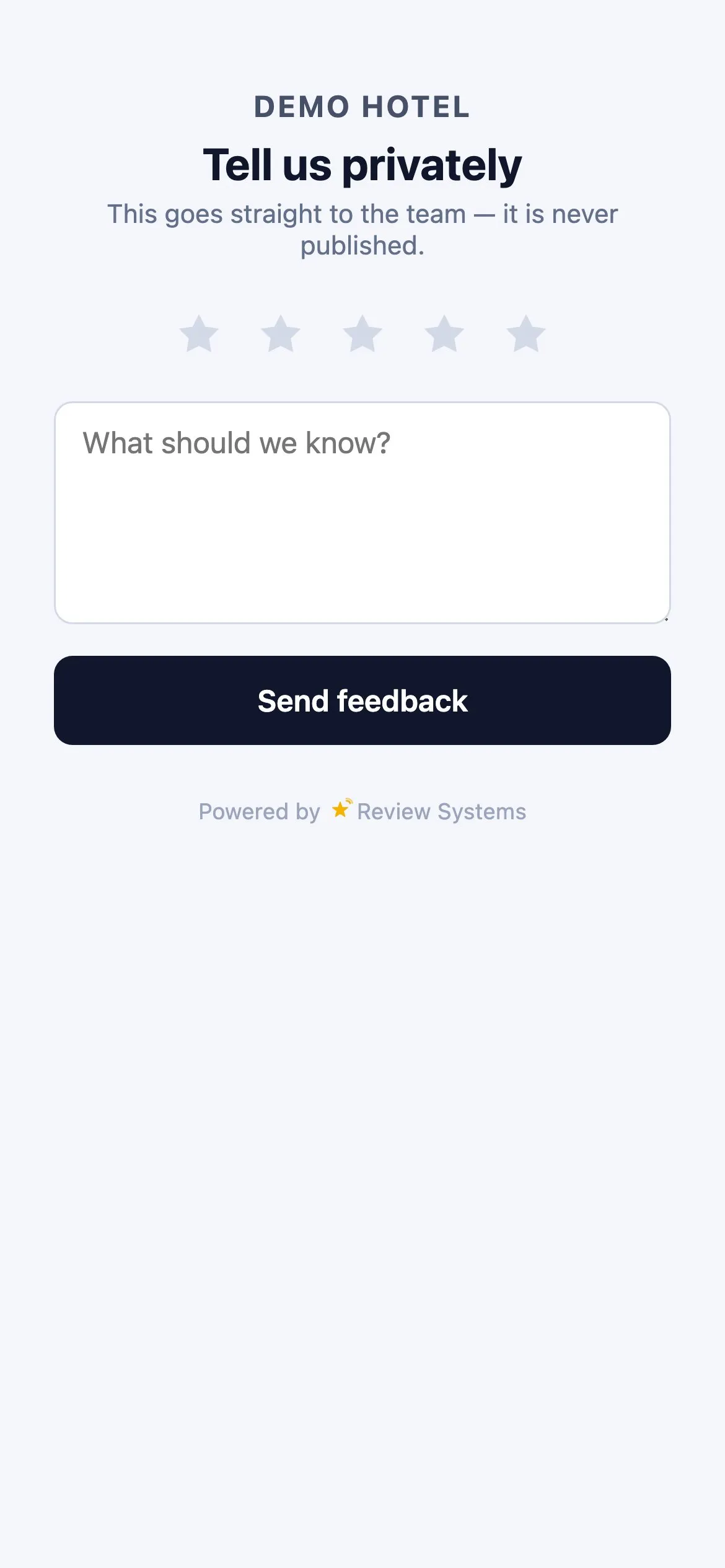
Every guest who scans lands on the same page: a filled button for one platform, the others one tap away, and a quiet “Tell us privately instead” link underneath. Nothing is asked before the buttons appear, nothing is taken away after, and nothing is offered. That is the whole design, and it is deliberate.
| Rule | What the page does |
|---|---|
| No selective solicitation | Same page for every guest; the public buttons are visible and tappable at every rating |
| Nothing in exchange | No offer anywhere in the flow; the page says what the code is for and stops |
| No pressure on the premises | The code sits on a card; the guest opens it alone on their own phone |
| No staff targets, no names | Scans are counted per spot — front desk, bar, rooms — never per person |
| Private feedback allowed | A private route sits beneath the public buttons; it is left out of the average and never published |
| The guest writes and posts | The helper is opt-in, assembles words from the guest’s own taps, and posts nothing |
Every guest sees every public review button at every rating; private feedback is an extra door, not a detour.
What about the draft helper?
The helper is a collapsed line — “Not sure what to write?” — that the guest chooses to open. At four or five stars it offers chips for what stood out and assembles a short draft the guest edits and posts themselves. Below four it offers the private route instead of a draft. The public buttons stay throughout.
Two details matter. The draft is built from the guest’s own choices with varied wording, so no two guests get the same paragraph — the pattern platforms look for. And nothing is posted for anyone: the guest copies, edits and submits on Google’s or Tripadvisor’s own site.
Offering a private route to a guest who rated low is not gating, because the public buttons were never taken away. Taking them away would be.
What should a hotel do on Monday?
Open your own review page as a guest would and check three things: the public buttons are there before any rating is asked, still there after a low one, and nothing on the page offers anything. Then check that no staff member has a number to hit. If all four hold, you are inside every rule on this page.
The rest — Google and Tripadvisor side by side, a code per spot, the one sentence staff say — is in how to get more Google reviews. The rules are not a constraint on getting reviews. They are a description of the only method that keeps them.

 ChatGPT
 Perplexity
 Claude
 Gemini · Google AI Mode
 Reddit
 X
X