When is the right moment to ask?
Ask when the experience is finished and still fresh: the end of the meal, the last drink at the bar, the minute at the front desk before the key card goes back. Growave’s round-up puts unprompted reviews at about one guest in ten and asked-for reviews at 65–83%. The gap is the moment, not the guest.
Two days later, in an inbox, the stay has become a memory and the email competes with everything else. At the spot, the guest is already holding the phone, the experience is still on the table, and the person who delivered it is still there.
What should staff actually say?
One sentence, said as an invitation: “There’s a code on the card if you’d like to leave us a review.” It names the thing to scan and stops. It does not ask for a rating, does not mention stars, does not ask the guest to name anyone, and does not wait for an answer.
That shape is deliberate. Google’s policy prohibits pressuring guests to review while on the premises and, since April 2026, names reviews that identify a staff member and asking staff to bring in a set number of reviews. A sentence that says “if you’d like” and then moves on is an invitation. A sentence that says “give us five stars and mention me” is three violations in a breath.
Train the sentence, not a script. Staff who have to remember a paragraph stop saying it by Thursday.
Where should the code be?
Put the code where the phone already is and where a person can point at it. The table at the end of a meal beats a poster by the exit; the bar is the same moment with a drink in hand; the front desk at check-out is the one spot every guest passes with a staff member present.
A room card works when the desk mentions it at check-in and rarely otherwise. A lift poster is usually the weakest spot on the property: nobody scans while the doors are closing. The spot-by-spot ranking, with print sizes, is in where to place QR codes in a hotel.
What should be written next to the code?
Write what the code is for, in the guest’s words: “Two taps to leave us a review.” EasyMenus’ adoption data puts the scan rate at 73% when the purpose is written beside a QR code and 34% when it is not — roughly double, from one line of text and no change to the code itself.
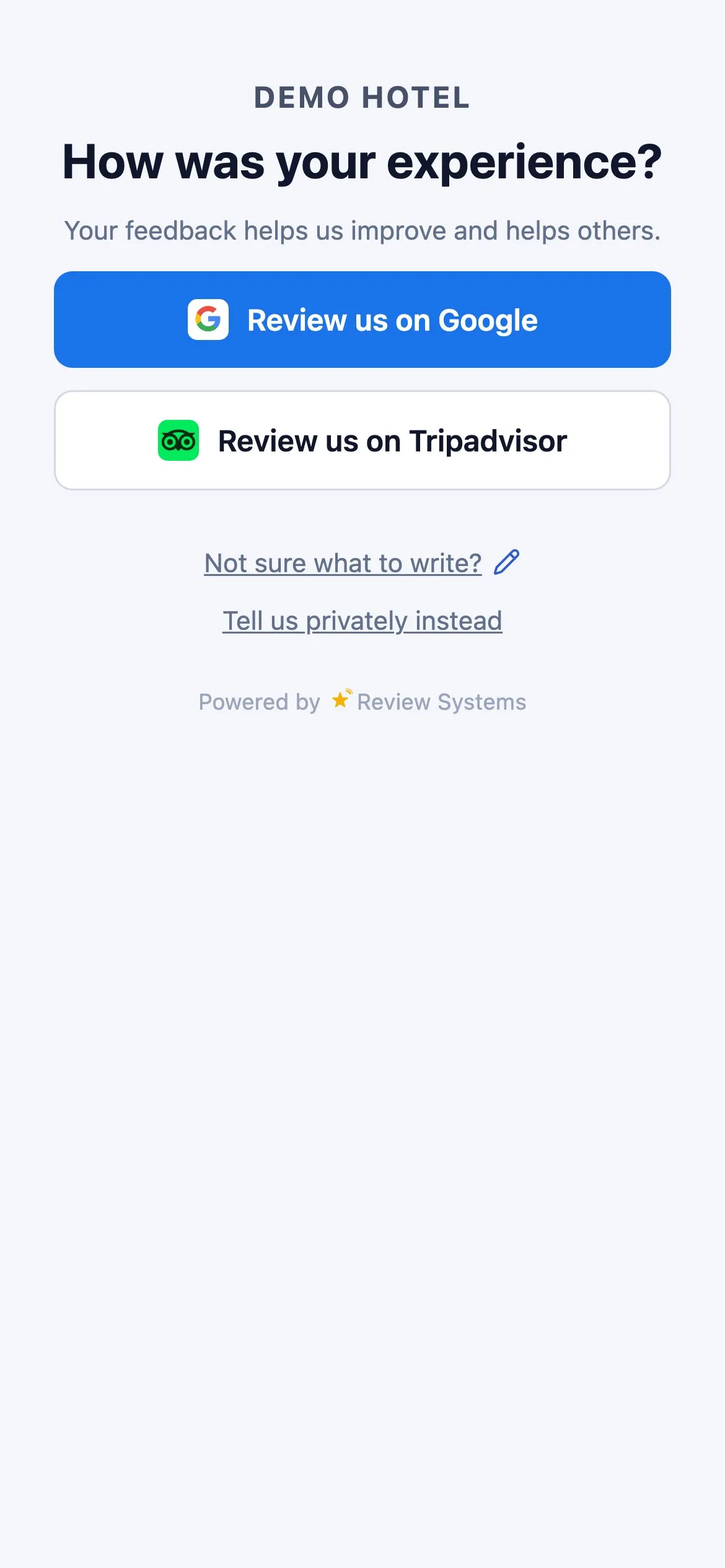
Keep the line about the guest, not the hotel. “Help us improve” is about you; “two taps, no app, no account” is about the thirty seconds you are asking for. Name both platforms if you offer both — a guest who has never used Tripadvisor will still recognise Google.
Does an in-person ask beat email and SMS?
They do different jobs and they do not compete. BrightLocal’s 2025 survey finds 27% of consumers respond best to an in-person ask and 40% to email; Birdeye reports the click rate on SMS review links fell from 8% to 6% while email held. The spot reaches guests the other two never see.
| Channel | Reaches | Moment | What it tells you |
|---|---|---|---|
| Code at the spot | Every guest who finishes there | While the experience is on the table | Which spot earned the review |
| Guests whose address you hold | Days later, in an inbox | That a review arrived | |
| SMS | Guests whose number you hold | Hours later, with a falling click rate | That a review arrived |
Use the channel you can measure. One printed link tells you reviews came in. One code per spot tells you the bar did it and the rooms did not, which is the only information that changes what you print next.
What must you never do?
Never offer anything in exchange for a review, never ask for a rating, never ask the guest to name a staff member, never stand over the guest while they type, and never take the public review buttons away from anyone. Every one of those is named in Google’s policy, Tripadvisor’s guidelines or the FTC’s 2024 rule.
In practice:
- Same invitation for every guest. The person who complained at breakfast gets the same sentence as the one who loved the view.
- Nothing in exchange. No dessert, no late check-out, no draw. Google’s help page calls paying for reviews “strictly prohibited”; Tripadvisor bans anything offered “irrespective of rating”.
- No numbers for staff. Compare spots, never people. A target per receptionist is now a named violation.
- Invite, then leave. The code sits on the card. Nobody watches the screen.
- The guest writes and posts. A helper may suggest words from the guest’s own taps — theirs to edit, nothing posted for them.
Every guest sees every public review button at every rating; private feedback is an extra door, not a detour.
How do you know the ask is working?
Give each spot its own code and read the scans after a fortnight. A spot with scans and no clicks has a landing-page problem; a spot with no scans has a placement problem; a spot with scans, clicks and reviews credited to it is the one to print more of.
The ask is not a campaign. It is a sentence staff say every day, a code that sits where the phone lands, and a line of text that says what it is for. The rest is reading which spot did it.

 ChatGPT
 Perplexity
 Claude
 Gemini · Google AI Mode
 Reddit
 X
X